Industries and Applications
- Chemical and petrochemical plants
- Refineries
- Nuclear power plants
- Conventional power plants
- Waste incinerators
- Sugar factories
- Sea water desalination plants
- Oil rigs
- Rail cars/train
- Aircraft industry
- Automotive industry
- Pressure tank industry
- Tube manufacturers
- Ferromagnetic tubes
- Condenser tubes
- Air-fin cooler tubes
- High-pressure tubes
- U-bended tubes
- Tube-sheet expansion zones
- Boiler and furnace tubes
Services
DELTA TEST ME Professional Expert Services
Meet the Eddy Current Experts
Eddy Current Inspections
Eddy current testing is a non-destructive inspection technique used on conductive materials to identify surface-level imperfections such as cracks, pores, or inclusions. The method takes advantage of the electrical properties of conductive materials to generate circulating currents known as eddy currents.
To begin the process, eddy currents are induced within the material using an excitation coil that produces an alternating magnetic field. When an alternating current flows through this coil, it excites the material and induces eddy currents. These currents, in turn, create their own fluctuating magnetic field, which is detected by a receiving coil. The alternating current in this coil differs from the original excitation current in both amplitude and phase. This variation makes it possible to detect material inconsistencies, such as foreign inclusions, compositional differences, or structural damage like cracks and voids.
The alternating current in the excitation coil produces what is called a primary magnetic field, which induces eddy currents in the test object. These eddy currents then generate a secondary magnetic field that, according to Lenz’s Law, opposes the change in the primary field. The receiving coil captures the voltage induced by the combined magnetic fields.
These high-frequency electromagnetic interactions are crucial for identifying cracks. By comparing the transmitted signal with the received one using suitable electronics, one can assess the condition of the test object's surface. For instance, if a surface crack is present, it will alter the flow of eddy currents, resulting in detectable changes in phase and amplitude.
Depending on the application, these signal variations can be evaluated either manually or automatically. Under optimal conditions, defect detection resolutions as fine as 30 µm are achievable. Since eddy current testing is contactless, it leaves the surface of the tested material clean and undamaged.
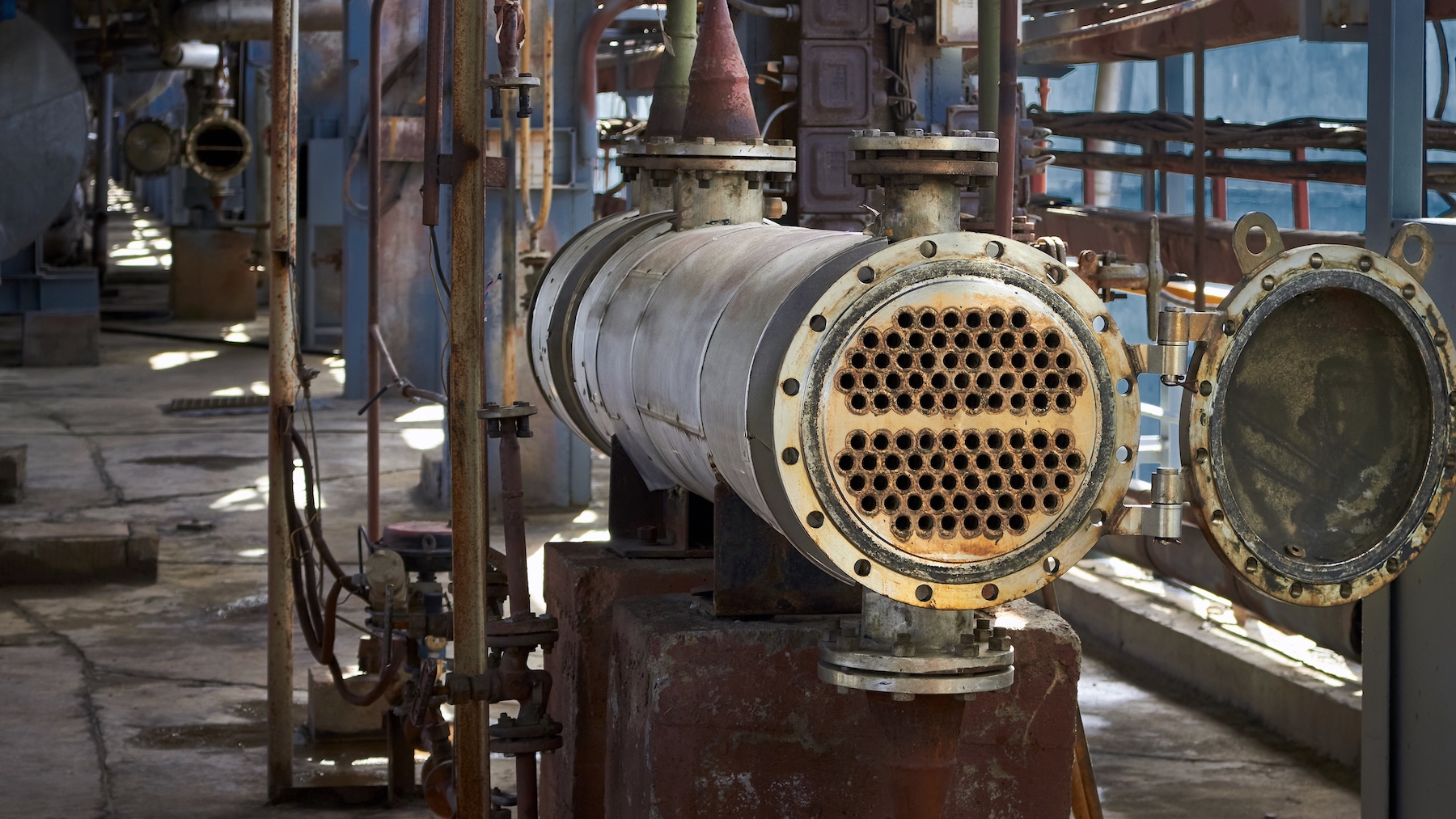
Heat exchanger inspections
Heat exchanger tubes, often made from a variety of materials, are frequently affected by corrosion. This can lead to leaks, which may cause further issues such as extended downtime while locating the problem and reduced system performance. In the worst-case scenario, environmental damage can occur. Significant financial losses for the company are also a potential consequence.
With the eddy current inspection methods offered by DELTA TEST ME, our customers benefit from targeted and efficient detection of tube defects. By using the latest computer technology, our skilled technicians and engineers provide a clear picture of the current condition of each heat exchanger system. Based on the specific type of damage identified, appropriate repair actions can be planned and taken. Regular inspections also help monitor damage progression, verify the effectiveness of protective measures, and support accurate life cycle assessments.
Heat exchanger tubes are critical components used in a wide range of industrial applications, including power and chemical plants. Their flawless operation is essential to the performance of entire systems. DELTA TEST ME offers its customers peace of mind. Routine inspections can reduce unplanned system failures by up to 95%, and the need for completely new tube systems or storing large quantities of spare tubes can be minimized. Additionally, the environmental risks and financial losses associated with production downtimes are significantly reduced.
Our testing system achieves a probability of detection (POD) greater than 80%, offering much higher reliability than alternative methods like IRIS, RFT, or MFL.
Moreover, our advanced inspection solutions include features such as automated signal analysis and precise defect location tracking, delivering the highest level of safety. We also offer specialized expertise in testing ferromagnetic heat exchanger tubes, including those made of carbon steel, duplex, or monel alloys.
Inspections are usually carried out with the tubes in place, although testing of loose tubes is also possible. Thanks to real-time signal analysis, test results are immediately available, allowing any necessary repair work to begin right away—saving valuable time.
IRIS inspections
The service portfolio of DELTA TEST ME is complemented by the IRIS testing system for tube inspection. Upon customer request—or when needed—this method can be used to confirm the results of previous eddy current tests. In addition, IRIS can also be employed as a standalone inspection technique.
Videoscope inspections
Modern videoscopy technology enables visual inspection of tubes and other hard-to-reach components. In combination with personnel certified according to ISO 9712, DELTA TEST ME ensures precise visual assessment, reliable defect analysis, and thorough documentation—supported by high-quality image and video technology.
Tube leak testing
Since none of the commonly used tube inspection methods can directly detect leaks, DELTA TEST has developed a specialized system capable of identifying even the smallest leaks with high precision using pressure testing. In this process, both ends of the tube are quickly sealed with specially designed plugs and then pressurized with air at approximately 1900 mbar.
The proprietary plugs from DELTA TEST ensure a 100% seal and can withstand excess pressures of up to around 6 bar. A highly sensitive digital pressure gauge is connected to the testing side of the system and can immediately detect any pressure drop in the millibar range if a leak is present.
The tube is pressurized with air up to 1.9 bar within seconds. If there is a leak, a pressure drop is recorded instantly. If not, the pressure remains stable thanks to integrated valves in the testing setup.
Thanks to the system’s fast response time, it is possible to test more than 100 tubes per hour efficiently.